The most recent national data, released by Victoria University’s Mitchell Institute in December 2025, confirms what many students and families already suspect. That the traditional pathway from school to further education has changed for good. 36 per cent of Australian Year 12 students did not receive an Australian Tertiary Admission Rank (ATAR), and alternative pathways now play a bigger role in education and career progression than ever before.
That’s more than one in three school leavers and it’s the most current official picture we have. Everything about the direction of travel, government funding, university admissions policy, and enrolment patterns, suggests it will keep shaping how students in 2026 and beyond move from school into a career. For students who dream of a career in emergency healthcare, understanding what that actually means can be the difference between giving up on paramedicine and finding another way in.
What the Latest Data Shows
Research published by Victoria University’s Mitchell Institute in December 2025, analysing 2024 Year 12 outcomes, the most recent national dataset available, found that approximately 64 per cent of Australian Year 12 students received an ATAR. meaning around 36 per cent did not. It’s the figure that schools, universities and families are working from right now, heading into 2026 and 2027 admissions.
The national figure also hides big differences between states and territories. In Western Australia, 62 per cent of Year 12 students did not receive an ATAR. In the Northern Territory it was 59 per cent, in Tasmania 49 per cent, and in Queensland 43 per cent. Even in New South Wales, where ATAR participation was highest, roughly one in five students still finished school without one.
These figures challenge the long-held assumption that finishing Year 12, getting an ATAR and heading straight to university is the standard route for every student. Increasingly, it just isn’t.
AT A GLANCE: ATAR RECEIPT BY STATE & TERRITORY
STATE OR TERRITORY
RECEIVED AN ATAR
DID NOT RECEIVE AN ATAR
New South Wales
79%
21%
Victoria
75%
25%
South Australia
72%
28%
Australian Capital Territory
66%
34%
Queensland
57%
43%
Tasmania
51%
49%
Northern Territory
41%
59%
Western Australia
38%
62%
36% of Australian Year 12 students did not receive an ATAR.
Alternative pathways now play a bigger role in education and career progression than ever before.
The most recent national data, released by Victoria University’s Mitchell Institute in December 2025, confirms what many students and families already suspect. That the traditional pathway from school to further education has changed for good. 36 per cent of Australian Year 12 students did not receive an Australian Tertiary Admission Rank (ATAR), and alternative pathways now play a bigger role in education and career progression than ever before.
That’s more than one in three school leavers and it’s the most current official picture we have. Everything about the direction of travel, government funding, university admissions policy, and enrolment patterns, suggests it will keep shaping how students in 2026 and beyond move from school into a career. For students who dream of a career in emergency healthcare, understanding what that actually means can be the difference between giving up on paramedicine and finding another way in.
The ATAR Isn’t Dead, But It’s No Longer the Only Way In
The ATAR is still an important, effective admissions tool for many students, particularly those moving directly from school into competitive university courses. But Australia’s education system has grown far more diverse.
Students can now progress through:
- Vocational education and training (VET)
- Enabling and bridging programs
- Previous higher education study
- Work and life experience
- Portfolio entry, early offers and other alternative admissions pathways
The Australian Government’s latest higher education statistics, 2024 data, the most recent complete release, show just how varied university entry has become.
48%
RECENT SECONDARY EDUCATION
Commencing domestic undergraduate students admitted on the basis of recent secondary education.
52%
OTHER ENTRY PATHWAYS
The other 52% entered another way:
Higher education
Enabling programs
VET qualifications
Work & life experience
That doesn’t mean 52 per cent of new students never received an ATAR, some may have received one earlier and chosen a different route anyway. What it does show is that for most commencing domestic undergraduates, their Year 12 result wasn’t the primary reason they got in.
The idea that there’s only one route from school to university, or to a successful career, no longer reflects how Australia’s education system actually works.
University Entry Has Been Shifting for Years
This isn’t a sudden trend. Universities Australia has previously reported that the share of first-year domestic Bachelor degree students admitted on the basis of secondary education fell from 50 per cent in 2008 to 45 per cent in 2018, while the share admitted via previous higher education or VET rose from 33 per cent to 38 per cent over the same period.
More recent government data uses revised admissions categories, so it can’t be read as one unbroken time series. But the direction is consistent, Australian higher education draws students from a genuinely wide range of backgrounds and entry pathways. In 2024, recent school leavers made up 48 per cent of domestic undergraduate commencements, the rest entered via previous higher education, VET, enabling study, work and life experience, or another recognised pathway.
For students weighing up Years 11 and 12 right now, that’s worth sitting with. Choosing not to pursue an ATAR does not mean choosing not to pursue further education.
Why This Trend Is Only Growing Through 2026 and Beyond
If anything, the shift away from a single ATAR-only pathway is accelerating, not slowing down.
In 2025, the Australian Government put additional Commonwealth Grant Scheme funding behind FEE-FREE Uni Ready enabling courses, making it cheaper and easier for students without a direct-entry ATAR to bridge into university.
For 2026, the Government has allocated 9,500 additional domestic undergraduate places, with 16,000 further fully funded Commonwealth Supported Places flagged for 2027 as part of a broader plan for 200,000 additional commencing places over the next decade.
More funded places and more recognised entry pathways point the same direction: universities and government policy are both moving away from treating the ATAR as the only front door.
For students finishing school in 2026 and applying for 2027 intake, that means more ways in than the generation before them had, not fewer.
A Different Pathway Doesn’t Mean a Lesser Pathway
For generations, the pathway after school looked simple…finish Year 12, get an ATAR, enter university, start a career. Today it can look very different!
- A student completes a vocational qualification, enters the workforce, builds practical experience, and later progresses to higher education.
- Another completes a VET qualification that leads straight into employment and keeps the door open to further study.
- A third uses an enabling program, prior study, or another alternative pathway to gain admission to study at university.
For some students, university is still the right first step.
For others, a vocational qualification is a more practical, career-focused way to start.
Neither pathway is automatically better.
The real question is whether the pathway suits the student, the career they’re chasing, and the way they learn best.
For Aspiring Paramedics, a Low ATAR Can Feel Like a Closed Door
This shift matters a lot for students considering a career in paramedicine. Entry into a Bachelor of Paramedicine can be competitive, and the ATAR or selection rank required for direct entry varies significantly between universities, campuses and admission years.
For a student who has always dreamed of becoming a paramedic, not receiving an ATAR, or falling short of the entry requirement for their preferred course, can feel like the end of that ambition.
It doesn’t have to be.
As universities increasingly recognise a broader range of qualifications and prior study, students may be able to apply through alternative admission pathways rather than relying solely on their Year 12 ATAR. Vocational education and training can be one of those pathways. Depending on the university and course, applicants may be considered on the basis of a previous VET qualification, prior higher education study, an enabling program, work and life experience, or other admission criteria.
Every university’s requirements are different, and completing a vocational qualification doesn’t guarantee entry into a Bachelor of Paramedicine, students should always check the requirements of the course they ultimately want to attend. But the broader message holds; not getting the ATAR you hoped for doesn’t necessarily mean giving up on becoming a paramedic.
How APC Helps Students Start Somewhere Else
At Australian Paramedical College, we see students arrive through every one of these routes. Some come straight from school. Some didn’t complete an ATAR. Some received an ATAR but not the selection rank their preferred course needed. Others discover an interest in emergency healthcare later in life.
For these students, vocational education can be an alternative starting point. APC’s nationally recognised qualifications in emergency and pre-hospital healthcare let students build practical skills and industry knowledge while working towards a formal qualification — no ATAR required to enrol.
What a pathway can look like
The pathway isn’t identical for every student, and progression to university always depends on the individual institution’s admission requirements. The old model (no longer the only one available): ATAR → university → career
APC PATHWAY (NO ATAR REQUIRED)
-
Graduate with HLT51020 Diploma of Emergency Health Care
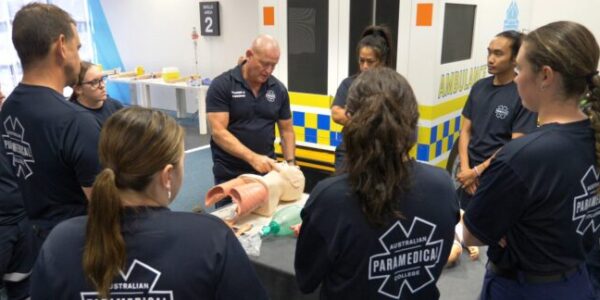
HLT51020 Diploma of Emergency Health Care. The Diploma combines flexible-online learning, with hands-on workshops and valuable clinical industry placements.
-
Launch your career
Start working immediately as an EMT, ESO, Event Medic, Industry Medic, Patient Transport Officer, and more!
-
Continue studying to become a registered paramedic
Study to become a Registered Paramedic. Several universities have a VET entry pathway, meaning you can gain university entry with a Diploma-level qualification. Many of our graduates have even received credits towards their degree, shortening their study time.*
For a student starting a VET qualification in 2026, that experience can already be feeding into a 2027 or 2028 university application, or straight into paid work in the sector.
For a student who thought a disappointing Year 12 result had closed the door on paramedicine for good, simply knowing these alternative pathways exist can change the whole conversation.
STUDENT SPOTLIGHT
Alan Leahy
Diploma | Father aiming to be a Paramedic
“There were some times when my motivation for study was down, especially having kids and work. The College must have seen that and were able to give me a call, […} and they were able to help me out and get me back on track.”
Students Need Better Information About Their Options
None of this means students should avoid the ATAR. If you already know you want a university course that requires one, the traditional academic pathway may still be your most direct option.
But no student should feel that skipping the ATAR at school automatically limits their future.
With more than one in three Year 12 students now finishing school without one, it’s on the education sector (APC included) to make sure students and families understand the full range of options. University, VET, apprenticeships and traineeships, enabling programs, alternative university entry, and combinations of study and work.
Not Sure Where to Start? Talk to Us
An ATAR may still be the most direct route into university for some students. For others, the journey begins somewhere else, and with more funded places and more recognised entry pathways arriving each year, that “somewhere else” is becoming a stronger option, not a fallback. A different starting point in 2026 doesn’t mean giving up on the destination.
If a disappointing ATAR, or no ATAR at all, has you rethinking a career in emergency healthcare, we’d like to help you map out what’s actually possible from here.
Frequently Asked Questions
Yes. The most recent official figures — 2024 Year 12 data, published by Victoria University’s Mitchell Institute in December 2025 — show approximately 64 per cent of Year 12 students received an ATAR, meaning around 36 per cent. more than one in three, did not. This is the latest national dataset available, and with government funding for alternative and enabling pathways continuing to grow into 2026 and 2027, the trend shows no sign of reversing.
No. In the most recent data, only 48 per cent of commencing domestic undergraduate students were admitted on the basis of recent secondary education. More than half entered through another pathway, such as VET study, an enabling program, prior higher education, or work and life experience, and the Government has continued expanding funded places and enabling course support since.
Direct entry into a Bachelor of Paramedicine usually requires an ATAR or selection rank that varies by university. However, some universities recognise alternative pathways, including relevant VET qualifications, for admission. Requirements differ by institution, so it’s important to check with your preferred course provider.
It can include completing a nationally recognised VET qualification in pre-hospital or emergency healthcare, gaining industry experience, and then applying to university through an alternative admissions pathway rather than a direct-entry ATAR requirement.
APC’s vocational qualifications in emergency and pre-hospital healthcare don’t require an ATAR to enrol. They give you practical skills and industry experience now, while keeping the door open to further study, including university, later on.
Sources
- Victoria University Mitchell Institute, Assessing the ATAR: Exploring the use of the Australian Tertiary Admission Rank (ATAR), December 2025 (analysing 2024 Year 12 outcomes)
- Australian Government Department of Education, Key Findings from the 2024 Higher Education Student Statistics
- Universities Australia, 2020 Higher Education Facts and Figures, October 2020 (p.33, Figure 22)
- Australian Government Ministers’ Media Centre, More Australians to start uni in 2026