At just 21, Tom Brown is working as an Emergency Response Technician, studying a Bachelor of Paramedicine, and building the kind of career most people spend a decade chasing.
The pathway that got him there started with one decision: enrolling in the HLT51020 Diploma of Emergency Health Care at Australian Paramedical College (APC).
Growing up in Chinchilla, a small town about two hours west of Toowoomba, Tom built his career step by step, using every opportunity to gain experience, develop his skills, and keep moving forward.
This is Tom’s story, in his own words – a story about filling gaps in knowledge, showing up to workshops, and letting one qualification open doors he never expected.
A Small-Town Start With Big-City Goals
Coming from a regional town, Tom knew that breaking into Emergency Healthcare would take more than ambition. University pathways into Paramedicine can be competitive, and for school leavers without a strong ATAR or a health-science background, the gap between “wanting to help people” and “being qualified to” can feel enormous.
That gap is exactly why Tom signed up with APC.
“The reason why I signed up to APC is to fill the gap in knowledge to get into uni.”
It’s a common story for people exploring how to become a paramedic in Australia without a direct university entry point. Rather than waiting and hoping for a university offer, Tom found a nationally recognised, practical stepping stone — one built specifically for people who want real skills before they commit to a full paramedicine degree.
Why He Chose Australian Paramedical College
For Tom, the decision to study with APC wasn’t just about ticking a box. It came down to the people.
He started the HLT51020 Diploma of Emergency Health Care with APC back in 2023, drawn in by the promise of hands-on, practical training rather than sitting through lectures with no real-world context. What sealed it for him was the relationship he built with his trainers during the workshops.
“Your teachers are really there for you at the workshops… you really get to build that relationship. That would be a major factor of applying here, coming to learn.”
The Diploma has 2 separate weeks of practical hands-on workshops, giving students the chance to actually practise the skills they’re learning – not just read about them. It’s this kind of immersive, supported environment that makes APC stand out among providers of emergency health care courses in Australia.
Practical Learning That Builds Real Confidence
If there’s one theme that runs through Tom’s story, it’s that theory alone was never going to be enough. He needed to do the work to feel ready for it.
The structure of the diploma gave him exactly that: intensive, in-person workshops where trainers were on hand to guide students through real scenarios, not just PowerPoint slides. It’s the difference between reading about patient care and actually practising it under supervision, with people who’ve done the job themselves.
That foundation – paired with a genuine support network – is what Tom says kept him moving forward.
“You get that foundation, a good support network, and that’s why I’m here.”
This is the essence of what it means to learn from real Paramedics in Australia: training delivered by people who’ve worked the job, not just taught it.
From Workshop to Workforce: How the Diploma Led to Employment
Here’s the part of Tom’s story that prospective students will want to pay attention to: his diploma didn’t just prepare him for the industry…
it directly led to his current job.
“I got into that industry because I got a call when I registered interest with Safety Direct Solutions (SDS) and they offered me a job up there, and I took it. I have APC to thank for that – starting off that journey and it peaking that interest.”
Today, Tom works for SDS in Cairns as an Emergency Response Technician, a role covering confined space and vertical rescue, hazmat response, and medical response – the kind of specialised, high-responsibility position often associated with FIFO and mining-adjacent emergency response roles across Australia. It’s a career many people don’t even know exists until they’re already on the pathway toward it.
His RII30719 Certificate III in Emergency Response and Rescue – completed through APC’s connection with industry partner Fire Safety Australia – gave him the specific qualification employers in that space were looking for. It’s a strong example of how APC’s industry partnerships turn classroom learning into real employment outcomes, not just certificates on a wall.
Alongside his current role, Tom continues to work toward the qualifications that will eventually support AHPRA paramedic registration as he completes his Bachelor of Paramedicine – proof that a diploma pathway and a university pathway aren’t mutually exclusive.
From Diploma to University: Building a Career Pathway
One of the most valuable parts of studying with APC is that it doesn’t stop at a single certificate. For Tom, the HLT51020 Diploma of Emergency Health Care became the launchpad into further study – including a Bachelor of Paramedicine at CQU and another certification through APC in HLT37525 Certificate III in Pathology (Pathology Collection).
Each qualification built on the last, creating a genuine paramedicine career pathway rather than a single, isolated course. For students weighing up a diploma pathway, Tom’s journey shows how a diploma can work alongside further study, not instead of it – he’s currently completing his Bachelor of Paramedicine in Rockhampton while already working in the industry.
Why Did He Choose to Also Study Pathology Collection
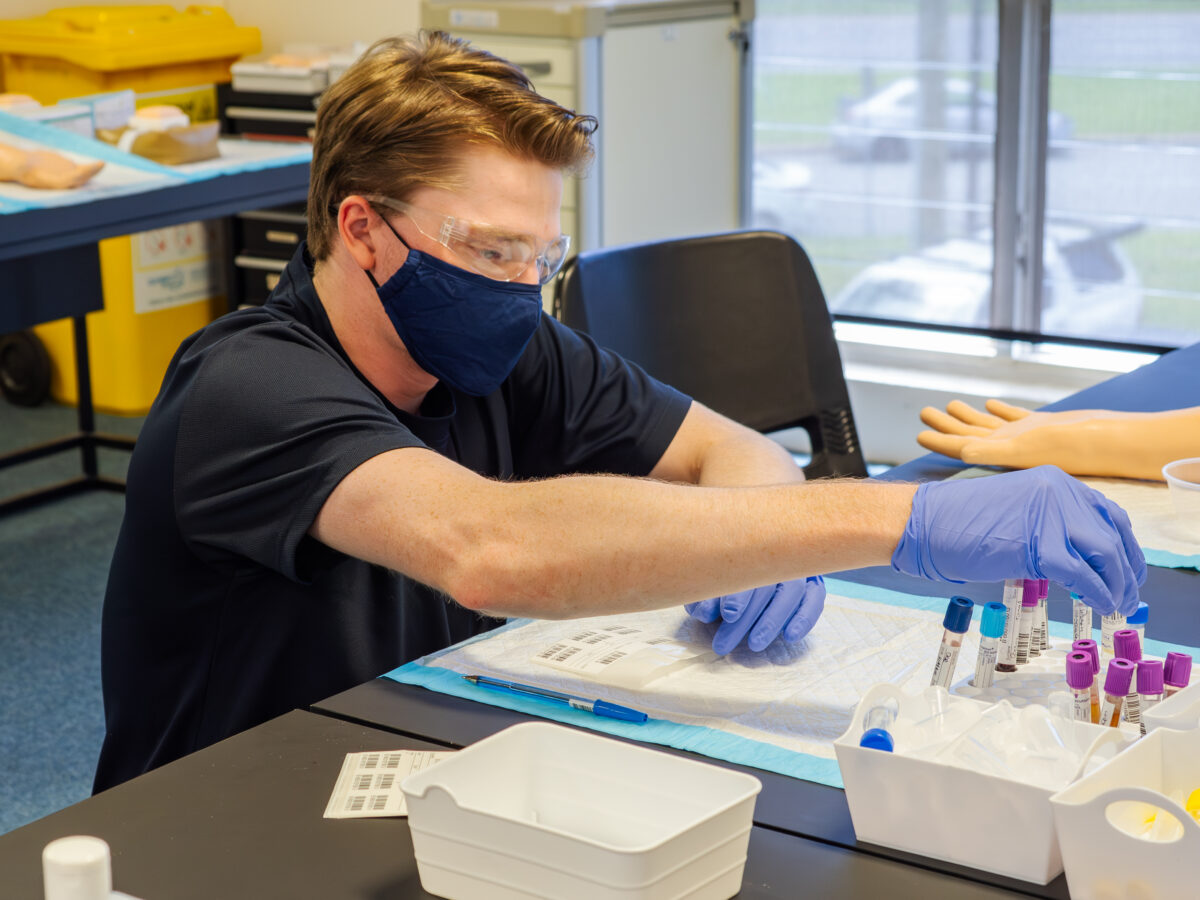
Due to the flexible-online course delivery Tom decided to study the HLT37525 Certificate III in Pathology (Pathology Collection) whilst on uni break to upskill and completed the in-person workshops when he was on holidays.
The Pathology Collection training left a real impression on Tom, particularly the practical, procedural side of the work:
“Probably for me, what stood out was the SOPs for your hygiene and how to interact with the patient — such as bringing them in, taking their information, getting to know what tests, picking what tube you need for said test, and how to do said test.”
For anyone considering a pathology collection course in Australia as either a standalone career or a stepping stone alongside emergency healthcare study, this is precisely the kind of attention to detail the training is designed to build — patient interaction, hygiene standards, and the technical accuracy that the pathology industry requires.
Tom’s Advice for Future Students
Ask Tom whether he’d recommend the Diploma of Emergency Health Care, and there’s no hesitation.
“Would I recommend this course? All the way, yes. It’s a way to go. It’s a great way to start.”
He’s just as direct about the Cert III in Pathology:
“Cert III is at the level where you can learn and pick up skills without feeling like you’re in the deep end.”
For anyone weighing up what is paramedicine as a career, or wondering whether they’re too old, too regional, or too underqualified to get started, Tom’s advice is simple:
The pathway exists, and it starts with one course.
Your Pathway Starts Here
Tom’s journey – from a small town outside Toowoomba to emergency response work in Cairns and a paramedicine degree in progress – didn’t begin with a university offer. It began with a decision to enrol in the HLT51020 Diploma of Emergency Health Care.
If you’re exploring how to become a paramedic in Australia, or simply want practical, industry-connected training that opens real career doors, APC’s diploma is built to get you there. With hands-on workshops, trainers who’ve worked in the field, and genuine pathways into further study and employment, it’s designed for exactly the kind of transformation Tom experienced.
Enquire about the HLT51020 Diploma of Emergency Health Care today and take the first step toward real-world training, practical workshops, industry placements, and a career in emergency healthcare. Apply now and start building your own pathway with Australian Paramedical College.
Frequently Asked Questions
It’s a nationally recognised qualification from Australian Paramedical College that builds foundational emergency healthcare skills and knowledge, often used as a pathway into further paramedicine study or emergency response employment. Read more here.
Diploma-level courses like the HLT51020 offer a practical, skills-based entry point into the emergency-healthcare industry, helping students build the knowledge and confidence needed to pursue further study, such as a Bachelor of Paramedicine (which is required to become a registered Paramedic).
Absolutely! The diploma can qualify you for a range of pre-hospital healthcare roles, including First Responder, Event Medic, Ambulance Transport Attendant, Emergency Medical Technician (EMT), and many other positions across the emergency care sector.
Our Pathology Collection course equips you with the skills to safely and effectively collect blood and other specimens, including drug and alcohol testing, and perform ECG procedures. Students will develop professional skills in medical terminology, patient communication, and adhering to industry standards to ensure specimen integrity and accurate results.
AHPRA registration applies specifically to registered paramedics. The Diploma from APC can support entry-level emergency response roles and act as a stepping stone toward further study and eventual AHPRA registration as a paramedic.