What is a State Ambulance Paramedic?
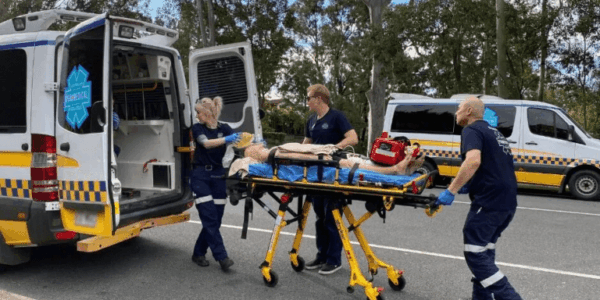
A State Ambulance Paramedic is a registered healthcare professional who provides advanced medical treatment in emergency and non-emergency situations. They work for government-run ambulance services in each state and territory and play a crucial role in saving lives and supporting the community.
If you’re driven to help others, enjoy fast-paced problem solving, and want a career with purpose, becoming a paramedic may be the ideal fit. Paramedics must think clearly under pressure, adapt rapidly to changing circumstances, and manage both physical and emotional demands. One moment you may be performing complex clinical interventions; the next, you’re supporting a patient’s family in distress.
It’s challenging – no question. But the impact you make every single shift is significant.
Typical duties of a State Ambulance Paramedic
A paramedic’s responsibilities vary from shift to shift, but commonly include:
- Assessing patients, identifying urgent medical needs, and determining appropriate interventions
- Performing advanced life support, including resuscitation, defibrillation, airway management, and medication administration
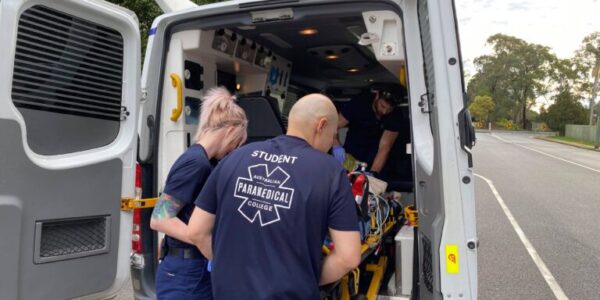
- Transporting patients to hospital safely while monitoring their condition
- Providing first aid education to community groups and essential services
- Attending public events where crowd density increases the risk of medical emergencies
- Maintaining ambulance equipment, ensuring vehicles are stocked, cleaned, and ready for deployment
- Documenting patient conditions, treatments provided, and clinical impressions clearly and accurately
Paramedics regularly work alongside police, firefighters, medical teams, and other emergency response professionals.
Average State Ambulance Paramedic Salary
State Ambulance Paramedics salaries greatly vary, based on location, education, skillsets and more. Despite this, qualified and experienced paramedics can earn over $140,000.*
*Source: How to Become a Paramedic – Potential Salary
How to become a State Ambulance Paramedic
To use the protected title Paramedic, you must:
- Complete a Bachelor of Paramedicine (or equivalent degree)
- Register with the Australian Health Practitioner Regulation Agency (AHPRA)
Entry into the degree can be competitive – which is why many future paramedics choose to build skills and experience first.
There are two main pathways:
1. Direct University Entry
This is the direct route for school leavers or recent graduates with an ATAR. Each university sets its own criteria, but you’ll typically need:
- A qualifying ATAR
- Prerequisite subjects (often English, biology, chemistry, or mathematics)
- Additional evidence such as interviews or written statements (varies)
Direct entry suits those ready to start university straight away.
2. VET Pathway (Vocational Education & Training)
The VET pathway allows you to build hands-on experience and industry skills before applying to university. Studying a nationally recognised pre-hospital health qualification , such as the HLT51020 Diploma of Emergency Health Care, can:
- Strengthen your university application
- Give you real-world emergency healthcare experience
- Reduce the number of subjects (or duration) of your degree depending on the university
- Lower your overall university costs
- Boost your confidence and clinical capability
- Open opportunities to work in private pre-hospital healthcare while you study
For many students, the VET pathway is the more practical and financially accessible option – especially if they want to test the career before committing to a degree.
Your Path Starts Here
Becoming a State Ambulance Paramedic is a long-term, high-impact career with unmatched purpose. Whether you’re fresh out of school, changing careers, or stepping up from private sector medic work, there’s a pathway that fits your situation.
Diploma graduate becomes Trainee Paramedic
Sarah Sgroi is a graduate of APC’s HLT51020 – Diploma of Emergency Health Care, successfully holding the title for her region as ‘NSW Student of the Year’ and is currently working as a Trainee Paramedic with NSW Ambulance. Whilst these are amazing feats, she’s most importantly a devoted and loving mother to two at home.
Sarah shares in this video, “APC was definitely the best choice for me because I already had a toddler at home so the only option I felt like I had was something that was completely flexible, so I could study at my convenience in an environment that was good for me.”
State Ambulance Paramedic skillset and qualities
Effective communication
Being able to connect and communicate with patients is an important skillset for State Ambulance Paramedics
Empathy & patient care
State Ambulance Paramedics need to demonstrate compassion on a day-to-day basis who may be feeling vulnerable
Collaborative
Values teamwork and effectively collaborates with other ambulance services, hospital staff and the local community when assisting with patient transfers