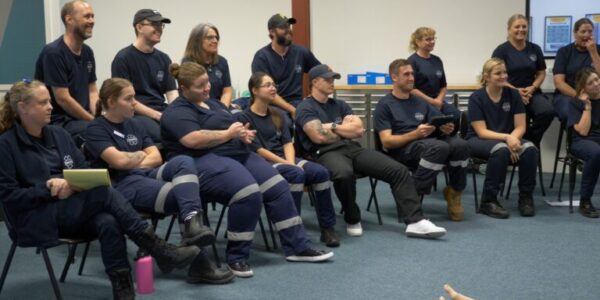
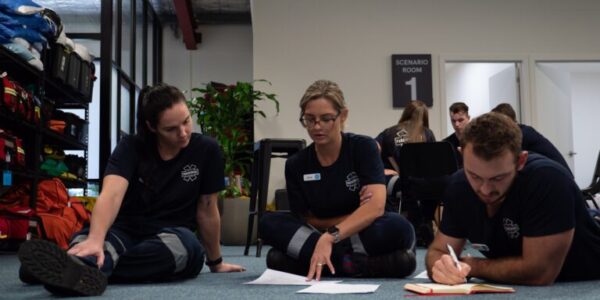
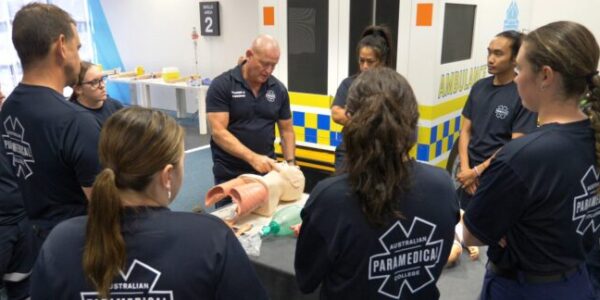
For students pursuing a career in paramedicine, entering university through a vocational education and training (VET) pathway is an increasingly common and effective route.
Rather than transitioning directly from school into a Bachelor of Paramedicine, many students complete a Diploma-level qualification first, like APC’s HLT51020 – Diploma of Emergency Health Care, building practical skills, academic confidence, and real-world healthcare experience before entering university.
Evidence from Australian universities shows that students entering via VET pathways often adapt faster, perform strongly, and contribute positively to the learning environment.
Why Universities Value VET-to-Degree Pathways
University paramedicine programs are academically demanding and heavily practical. Students are expected to quickly develop clinical competence, theoretical understanding, and professional behaviors.
VET pathway students often arrive with:
- Prior exposure to clinical terminology and equipment
- Experience in patient-facing healthcare environments
- Greater confidence in practical workshops
- Stronger engagement in classroom learning
These attributes support both individual success and cohort-wide learning outcomes.
Insights from Charles Sturt University
Senior Lecturer of Paramedicine at Charles Sturt University, Sam Willis, has observed consistent benefits among students who enter the Bachelor of Paramedicine via vocational pathways such as those delivered by Australian Paramedical College (APC).
Strong Transition into Practical Classes
According to Willis, pathway students transition smoothly into practical workshops.
They are able to:
- Perform clinical skills confidently
- Apply prior hands-on experience
- Meet practical competency expectations alongside direct-entry students
Their previous exposure to healthcare environments gives them a clear advantage when learning new practical skills.
Leadership and Peer Influence in the Classroom
Pathway students often emerge as informal leaders within university cohorts.
Willis notes that:
- Other students frequently seek their guidance
- They become role models during practical sessions
- They help peers consolidate skills through peer-to-peer learning
This behavior contributes to a more engaged and collaborative learning environment.
High Engagement in Theoretical Learning
The benefits are not limited to practical skills.
In theory-based classes, pathway students are often:
- More confident asking and answering questions
- Faster to engage with complex concepts
- More willing to participate in discussions
This level of engagement reflects a strong foundational understanding developed during prior vocational study.
Contribution Through Peer Tutoring and Mentorship
Many universities use peer tutoring systems to support student learning. According to Willis, pathway students are frequently selected as mentors within these programs.
Their ability to:
- Explain concepts clearly
- Demonstrate clinical skills
- Support less experienced students
highlights both academic competence and professional maturity.
Why Diploma-to-Degree Pathways Support Long-Term Success
The success of pathway students is not accidental. Diploma-level programs focus on:
- Applied learning rather than abstract theory
- Realistic exposure to healthcare environments
- Development of professional behaviours early
- Repetition and reinforcement of core concepts
This creates students who are not only academically capable, but practice-ready.
Benefits Beyond University Performance
Students who follow a Diploma-to-Degree pathway often graduate with:
- A Bachelor degree, enabling AHPRA registration and the paramedic title
- A Diploma qualification in healthcare
- Years of relevant industry experience gained before or during university
From an employer perspective, this combination is highly attractive.
Graduates bring:
- Clinical familiarity
- Strong communication skills
- Workplace maturity
- Proven commitment to the profession
About Australian Paramedical College
Australian Paramedical College (APC) is a nationally recognised Australian RTO delivering vocational healthcare and emergency services education.
Since 2011, APC has supported thousands of students into healthcare careers and university pathways through qualifications aligned with industry and higher education expectations.
A Proven Pathway, Not a Shortcut
University pathways from Diploma to Degree are not about avoiding challenge, they are about building capability before stepping into it.
Evidence from universities shows that students who follow this route often:
- Adapt faster
- Engage more deeply
- Support their peers
- Perform strongly across both theory and practice
For many aspiring paramedics, it’s not just a pathway into university, it’s a pathway to long-term success.