If you’re researching how to become a paramedic in Australia, you’ll encounter strong and often conflicting opinions about paramedic pathway courses. Some sources recommend going straight to university. Others suggest completing a preparation or pathway qualification first.
So what’s the reality?
Short answer: Paramedic pathway and preparation courses do not replace a university degree, but they can improve academic readiness, provide real-world healthcare experience, and strengthen long-term employability for the right student.
This article explains what paramedic pathway courses are designed to do, when they add genuine value, and how preparation courses such as APC’s HLT51020 – Diploma of Emergency Health Care qualification fit into a long-term paramedic career pathway.
What Is a Paramedic Pathway or Preparation Course?
A paramedic pathway or preparation course is a nationally recognised vocational qualification designed to prepare students for entry into a Bachelor of Paramedicine or related university degree.
These courses focus on building foundational healthcare knowledge, clinical awareness, and professional readiness before or alongside university study.
At Australian Paramedical College (APC), preparation pathways include HLT51020 – Diploma of Emergency Health Care, HLT41120 Certificate IV in Health Care, and HLT31120 Certificate III in Non-Emergency Patient Transport, aligned to emergency healthcare and first responder environments.
Importantly, these courses are not paramedic degrees and do not qualify graduates to practise as paramedics. Their role is preparation, not substitution.
What Do You Learn in a Paramedic Preparation Course?
Paramedic preparation courses focus on the practical and theoretical foundations of paramedicine and emergency healthcare, equipping students with the knowledge, skills, and confidence required to operate safely and professionally in pre-hospital and patient-facing environments.
These courses are designed to introduce students to the scope of practice and responsibilities of first responders and emergency healthcare workers, while preparing them for further study at university level.
Core Knowledge, Skills and Scope Covered
Students are trained to:
- Use medical equipment and clinical terminology correctly and professionally
- Safely assess, monitor, and triage patients to determine appropriate care pathways
- Provide emergency healthcare management for a range of conditions, including:
- Cardiac arrest
- Asthma and anaphylaxis
- Chest pain and suspected cardiac events
- Trauma, burns, and bleeding
- Overdose and poisoning
- Seizures and stroke
- Pain management and patient comfort
- Transport patients and manage care during on-road operations
- Confidently support patients experiencing mental health conditions
- Respond effectively to road traffic accidents, mass casualty incidents, and disaster scenarios
- Communicate clearly and professionally with colleagues, other healthcare professionals, patients, and families from diverse backgrounds
- Meet legislative and regulatory requirements, including accurate patient care documentation and reporting
- Maintain personal and team wellbeing, manage stress, and support colleagues in high-pressure environments
The specific scope of practice varies by qualification. For detailed role boundaries, refer to APC’s HLT51020 – Diploma of Emergency Health Care scope of practice.
How Learning Is Delivered
Learning is delivered through a blended model that reflects how emergency healthcare is taught and practised in the real world, including:
- Online learning for theory, clinical concepts, and academic development
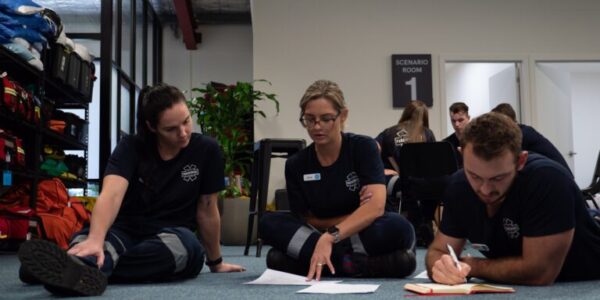
- Face-to-face practical workshops to develop hands-on skills in simulated environments
- Real-world clinical placement, exposing students to patient-facing healthcare settings
This approach ensures students understand not just emergency healthcare theory, but the realities, responsibilities, and pressures of working in the sector.
Do You Need a Pathway Course to Become a Paramedic?
No. Many students are accepted directly into university paramedicine degrees and succeed.
However, pathway and preparation courses exist because:
- University places are competitive
- Not all applicants meet academic entry requirements
- Some students are not yet ready for the academic or clinical demands of paramedicine
For school leavers with lower ATARs, mature-age students, or career changers, a preparation course can provide a recognised alternative entry pathway and reduce the risk of struggling early in a degree.
How Universities View Pathway and Preparation Courses
Many Australian universities recognise nationally accredited vocational qualifications within their admissions frameworks, particularly for applicants without traditional entry scores.
Beyond entry, these courses demonstrate:
- Academic capability in healthcare-related subjects
- Familiarity with clinical concepts and terminology
- Commitment to the profession
- Readiness for tertiary study
Universities are not only selecting students who can gain entry, they are selecting students who are more likely to progress and complete their degree. Learn about the Pathway benefits from Senior Lecturer of Paramedicine at Charles Sturt University, Sam Willis here.
Academic and Clinical Preparation Reduces Risk
Paramedicine degrees are academically demanding and emotionally challenging. Students who arrive unprepared often struggle in the first year, particularly during placements.
Preparation courses help students develop:
- Study discipline and academic confidence
- Comfort in clinical and simulated environments
- A realistic understanding of healthcare work
- Professional behaviour expected in the sector
This preparation often results in smoother transitions into university study and reduced first-year attrition.
Gaining Real-World Experience Before and During University
One of the most practical advantages of APC’s courses is that they can lead to entry-level healthcare employment, depending on the qualification and employer.
Examples of Roles Graduates May Access
- First Responders
- Private Sector Medics
- Event Medics
- Patient Transport Officers
- Medical Emergency Services Officers
- Ambulance Transport Attendants
- Emergency Medical Technicians
- Healthcare or clinical assistants
- Support roles within emergency or pre-hospital services
These roles allow students to continue building experience while studying at university, rather than waiting until graduation to enter the workforce.
Building a Stronger Resume by Graduation
By the time many preparation-pathway students graduate from university, they often hold:
- A Bachelor degree, enabling AHPRA registration and the Paramedic title
- A Diploma or Certificate qualification in healthcare
- Several years of real-world industry experience
From an employer perspective, this combination is often more attractive than a university degree alone with limited practical exposure.
Graduates who follow this pathway typically demonstrate:
- Stronger professional maturity
- Familiarity with healthcare systems
- Faster transition into operational roles
- Proven commitment to the profession
Preparation courses don’t replace university – they multiply its value.
Not All Pathway Courses Are the Same
Criticism of pathway courses usually arises when programs:
- Overpromise outcomes or imply guaranteed entry
- Blur the distinction between vocational training and a degree
- Lack meaningful clinical exposure
- Are not aligned with university or industry expectations
A credible pathway course is transparent about its role and focused on long-term outcomes, not shortcuts.
What a Paramedic Pathway Course Will Not Do
To be clear:
- It will not make you a paramedic
- It will not replace a Bachelor of Paramedicine
- It will not guarantee university entry
Its role is preparation, progression, and employability development.
So, Do Paramedic Pathway Courses Help You Become a Paramedic?
For the right student, yes.
They help by:
- Improving readiness for university study
- Strengthening applications where direct entry isn’t possible
- Building real-world healthcare experience early
- Producing graduates with stronger employment outcomes
They are not a shortcut, they are a strategic, long-term approach.
Starting With the Right Foundation
Becoming a paramedic is a multi-year commitment. Rushing into university unprepared can lead to unnecessary stress, delays, or withdrawal.
For many aspiring paramedics, beginning with a Paramedic Preparation Course provides the confidence, capability, and experience needed not just to graduate – but to build a sustainable career.
That’s the difference between earning a degree and building a career.
About Australian Paramedical College
Australian Paramedical College (APC) is a nationally recognised Australian RTO delivering vocational healthcare and emergency services education.
Since 2011, APC has supported thousands of students into healthcare careers and university pathways through qualifications aligned with industry and higher education expectations.