Re-published 5 May, 2026.
Do you want to pursue a career with St John Ambulance Western Australia as a Paramedic? Servicing the entire western third of Australia, consisting of mainland and island coastline, Western Australia is a beautiful place to live and work.
If you want to “be part of something meaningful”, consider this blog as your sign! Continue reading to understand the requirements needed to work with St John Ambulance WA as an Ambulance Paramedic, the onboarding processes of recruitment, employee benefits, salary estimates of qualified employees.
Who are St John Ambulance (Western Australia)?
St John Ambulance Western Australia (best referred to as St John WA) is WA’s jurisdictional ambulance service. It provides medical support to over 2.5 million individuals annually, with its capital city, Perth, holding a population of approximately 2.1 million alone*.
*Source: For Teachers, for Students (2024)
St John Ambulance WA is proud to provide ambulance and first aid services. Employing over 1,300 paid staff and holding 4,500 volunteers, they aim to provide quality support to all communities, no matter where they reside throughout the territory*.
*Source: St John WA (2024)
Common St John Ambulance roles:
St John WA employs for a number of positions throughout the state, depending on prior education and skillsets.
Across 160 stations, St John WA employs and volunteers for:
- Ambulance Paramedics (AP1–AP3)
- Grade 2 Ambulance Officers
- Patient Transport Officers
- Communications Officers
- First Aid Trainers
- Administration and operational support roles
How to work for St John Ambulance WA
If your ultimate goal is to work as a qualified Ambulance Paramedic with St John Ambulance WA, refer to the below steps to assist
Step 1: Complete the Required Qualification
No matter where you live in Australia, the pathway to becoming a paramedic is fairly consistent. To work under the title Paramedic, you must complete a Bachelor of Paramedic Science (or similar degree).
The good news? This degree fully prepares you for the role.
The challenge? Entry can be competitive.
Some universities require an ATAR of 87 (OP7 equivalent), which can make direct entry difficult for many students.
Alternative Pathway: VET Entry into University
If you don’t meet ATAR requirements, there is another option.
APC offers a VET (Vocational Education and Training) pathway, allowing students to gain entry into university through further study.
Most clinical St John Ambulance WA jobs require one of the following:
- Bachelor of Paramedicine (for paramedic roles)
- HLT51020 Diploma of Emergency Health Care (pathway option)
- HLT41120 Certificate IV in Health Care (for entry-level support roles)
What is VET (Vocational Education and Training)?
VET stands for Vocational Education and Training. It focuses on practical, hands-on skills through qualifications such as Certificates, Diplomas, and Advanced Diplomas.
At APC, available courses include:
- HLT51020 Diploma of Emergency Health Care
- HLT41120 Certificate IV in Health Care
- HLT31120 Certificate III in Non-Emergency Patient Transport
- HLT37525 Certificate III in Pathology (Pathology Collection)
The HLT51020 Diploma of Emergency Health Care is the most popular pathway for students working towards becoming a paramedic.
Graduates may be eligible to apply for VET entry into university, potentially receiving:
- Credit towards a Bachelor of Paramedic Science
- Reduced course fees
- Recognition of Prior Learning (RPL)
Many APC graduates have successfully progressed to select universities using this pathway.
Step 2: Gain Clinical or Volunteer Experience
Experience is highly valued when applying for St John Ambulance WA jobs. This may include:
- Clinical placement hours
- Volunteer ambulance support roles
- First aid event coverage
- Healthcare assistant roles
Step 3: Apply Through St John WA Recruitment
Applications for St John Ambulance WA jobs are submitted through their official careers portal. The process typically includes:
- Online application
- Medical and fitness assessments
- Interview and scenario testing
- Driving and operational checks
Work as a Grade 2 Ambulance Officer (St John Ambulance WA)
As a recent graduate, you may be offered a Grade 2 Ambulance Officer role during a recruitment drive. While you won’t immediately work under the title of Paramedic, this role puts you on the pathway toward becoming one.
If successful, you’ll complete the same induction as Ambulance Paramedics, with slightly different mentoring support. Over a 16-week period, you will:
Work on-road alongside a paramedic
Receive performance feedback and reporting
Complete a 3-month probation period
Typically, you’ll remain in this role for around 12 months before progressing to an Ambulance Paramedic position.
Work as an Ambulance Paramedic (St John Ambulance WA)
There are two main pathways into this role:
1. Internal progression
Complete approximately 12 months as a Grade 2 Ambulance Officer
2. External experience
Have at least 24 months’ experience as a paramedic in Australia, New Zealand, or London
To be eligible, you’ll also need:
- A full driver’s licence
- Australian working rights or a valid visa
- Registration with AHPRA after completing your degree
Once accepted, you’ll:
- Complete a 4-week on-road induction with a qualified paramedic
- Become familiar with WA operations
- Be rostered with junior Ambulance Officers, providing support and guidance
- Undertake a 3-month probation period
Other Paramedic Roles (St John Ambulance WA)
There are additional specialised roles within the organisation, including:
- Clinical Support Paramedics
- Critical Care Paramedics
- Country Paramedics
These roles are typically offered through internal progression.
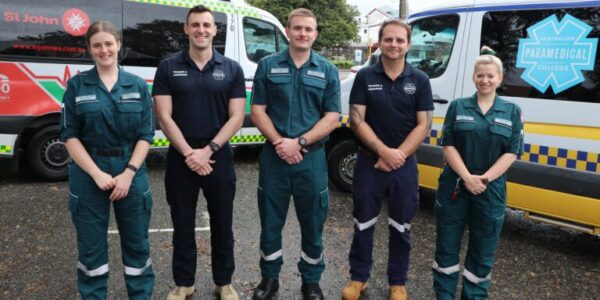
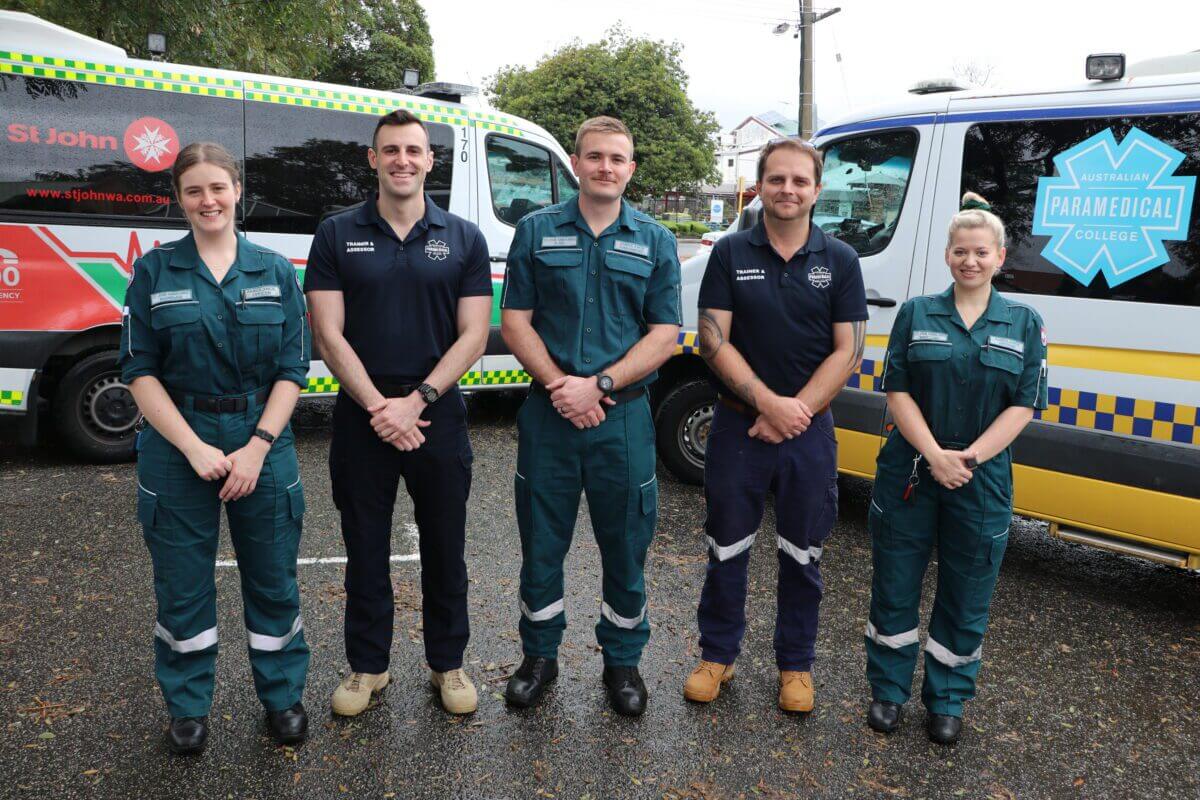 St John Ambulance WA and APC announcing our partnership in late 2022.
Benefits of working with St John WA
St John WA offers an array of employee benefits to their workers includeing:
- First Aid Training (includes training for one immediate family member – living at the same address)
- Discounts on First Aid Kits and Equipment
- Salary Packing to maximise income
- Extra 5% Contribution on Superannuation
- Health and Wellbeing program valued at $500 (towards gym, health clubs, pilates, yoga etc.)
- Health Insurance Discounts
- Free Ambulance Cover
Average salary of a Paramedic or Ambulance Officer working with St John Ambulance WA
Having a supportive salary is important to many if not all. That’s why it’s so great that as an employee of St John Ambulance WA (and all other jurisdictional ambulance services) have an enterprise agreement that clearly outlines what you can expect for your salary once employed. At the date of this blog release, a three-year agreement has been signed until 2026 which offers:
- Wage increase of 5% back paid to 1 July 2023;
- Wage increases of 5% to apply from 1 July 2024; and
- Wage increases of 4% to apply from 1 July 2025
*Source: St John Ambulance Western Australia Patient Transport Services Enterprise Agreement 2023 (2024)
To review the figures, please see below:
The salary of a Grade 2 Ambulance Officer with St John Ambulance WA
$90,000 – $95,000 per year (base + standard allowances)
* Note: entry-level operational ambulance officer roles sit slightly below or around this range depending on roster loadings
The salary of an Ambulance Paramedic (A1) with St John Ambulance WA
For individuals working as an Ambulance Paramedic (A1), you could be offered upwards of $104,000.00 annually.
*This figure generally increases with seniority (AP2, AP3)
Looking to apply?
If you’ve read this far, you’re likely excited to start pursuing your dream career with St John Ambulance WA and we’re equally excited to help!
Click the button below to further review how APC’s HLT51020 Diploma of Emergency Health Care, a paramedic training and paramedicine course, can offer you the chance to apply for VET entry into a paramedicine degree.